Search This Blog

Tuesday, June 3, 2014

Uninspired

I have not written any posts recently for a a few reasons foremost among them was an extended bout with strep throat--an experience I could have lived without. Today, I am just happy to swallow without pain and experience no fever. Do not fear faithful readers. I sill return soon. I am attending a conference this weekend at Syracuse University on the philosophy of disability. Link: http://spawn2014.syr.edu I was not involved in its organization and am merely a discussant. I am looking forward to this event and dreading it. I get to meet Dominic Wilkinson, author of Death or Disability? As one might guess for a scholar coming out of the Uhero Bioethics Centre he comes firmly down on the side that life with a disability is a fate worse than death. I am looking forward to asking him exactly how much time he has ever spent with a person with a disability.  Jeff McMahon will be present too. A man that in 2008 unfavorably compared Eva Kittay's severely disabled daughter to a pig (yes, a pig). On the positive side Anita Silvers, Eva Kittay, Lenny Davis and other top notch disability scholars will be present. At worst, dinner should be wildly entertaining. Wondering how the table will break down in terms of camps of thought.

Unrelated--well sort of. I came across the following "If Healthy Pregnancies were Treated Like Special Needs Pregnancies". I hate the title for sure. I hate the blog title too. But I sadly shook my head that this essay is spot on and reproduced in flu below. Link: http://wifeytini.com/2014/06/03/if-healthy-pregnancies-were-treated-like-special-needs-pregnancies/#comments


If healthy pregnancies were treated like special needs pregnancies


Mr. and Mrs. Johnson, good afternoon. I’m Doctor Dumas, a visiting obstetrician in Doctor Kwak’s practice. It’s nice to meet you.
Look, there’s no easy way to say this, so at the risk of sounding blunt, I have some bad news.
The technician and I reviewed your scans and we found that you’re about ten weeks along with a human fetus. I’m not seeing any abnormalities as far as growth or bone and organ structure, but you’re very clearly pregnant with a human baby. In all likelihood, you’ll carry the baby for another thirty weeks until your amniotic sac ruptures and the baby exits your body vaginally. In some cases, your baby will be extracted via cesarean section. Either mode carries its own set of risks and is extremely painful. We’re so very sorry.
Your baby will be born, unless you suffer a miscarriage or stillbirth. After his birth, he will live, and then he will die. He will live until he dies. I’m sorry to say that life is terminal. The fatality rate for human beings is 100 percent. If he survives past birth, you’d just be living on borrowed time.
How long does he have? We’re not sure. Humans typically live until their mid-seventies, depending on where they’re born and a variety of other factors. But many die at age 5, or 15, or 30. We can’t predict with any certainty how long he has, but we know that death is an inevitability. You probably have a history of death in your family.
We’re also sad to say that your child has cancer. Well, not right now, but statistically it’s possible. You’re carrying a human child, and fourteen thousand of them every single year get some kind of cancer. In fact, the second leading cause of death between kids ages 5-14 is cancer. This is second only to unintentional accidents like a gun misfiring or some sort of collision. So if your baby doesn’t die in a car wreck first, I’m afraid there’s a chance he’ll get cancer. I’m so sorry.
If by some chance we prolong his life until age 15, the odds don’t look good then either. It’s not totally hopeless — I mean, never say never, right? — but teen mortality rates are climbing. There’s always a risk of car accidents, overdose, and particularly suicide. The suicide rate is particularly troublesome. I’m a numbers man, so I’ll give it to you straight: Thirty three thousand teenagers committed suicide in 2006. And being born is the leading cause of eventually committing suicide.
I know you have a lot to think about. Just try to breathe. There are a lot of options. It’s important to take care of yourself first, and your marriage. Children are a big contributor to divorce. Almost forty percent of divorced people have children at one point. Suicide, cancer, divorce … if the baby survives birth, you’d be bringing him into a pretty questionable environment. You’ve got problems coming at him from all angles. Multiple problems. Quality of life is important to consider.
This is the part of my job I hate. I can only imagine how shocking and upsetting this is for you. Unfortunately, we have even more difficult news. Your Chorionic Villus Sampling test came back with some red flags. Our tests indicate that you’re very likely having  a boy. This occurs typically in half of all pregnancies, and nobody really knows why. We know the Y chromosome plays a part, and we know the father is the carrier.
These things just happen.
Risks? Well, males typically have higher testosterone, which could lead to anger issues. They’re more likely to abuse alcohol and much more likely to rape. Something like 90 percent of all homicide offenders are men, and the vast majority of inmates in the penal system are men as well.
You have a 1 in 2 chance of having another boy, should you choose to get pregnant again. You could also try for a girl, but there are risks involved with a girl as well. Girls are muchmore likely to be raped and make up the vast majority of sex-related homicides. 100 percent of people who die in childbirth are women. Women are less likely to commit suicide and rape other people, but they’re infinitely more likely to die of ovarian and breast cancer. There are significant risks, whatever you do. I’m afraid it’s inescapable.
Well, you have a lot of options. You can take your chances, or you can terminate. I can’t make that decision for you, but I will say that terminating now will let you start the healing process that much sooner. It’s early in the pregnancy, and it would probably be easier to do it now rather than wait twenty five years to see if he turns out to be a rapist.
On the bright side, he could be worse. Your baby is caucasian. Black children are three times more likely to grow up in poverty, and black men are twenty times more likely to be sent to prison than white men. The outcome is just very poor for people of color. I wouldn’t wish that on anybody. Just be grateful he isn’t a girl. Or black. Or a black girl, God forbid.
So. Talk it over. You two have a lot to discuss.

Friday, May 23, 2014

The Disability Gulag at Hofstra University Commencement

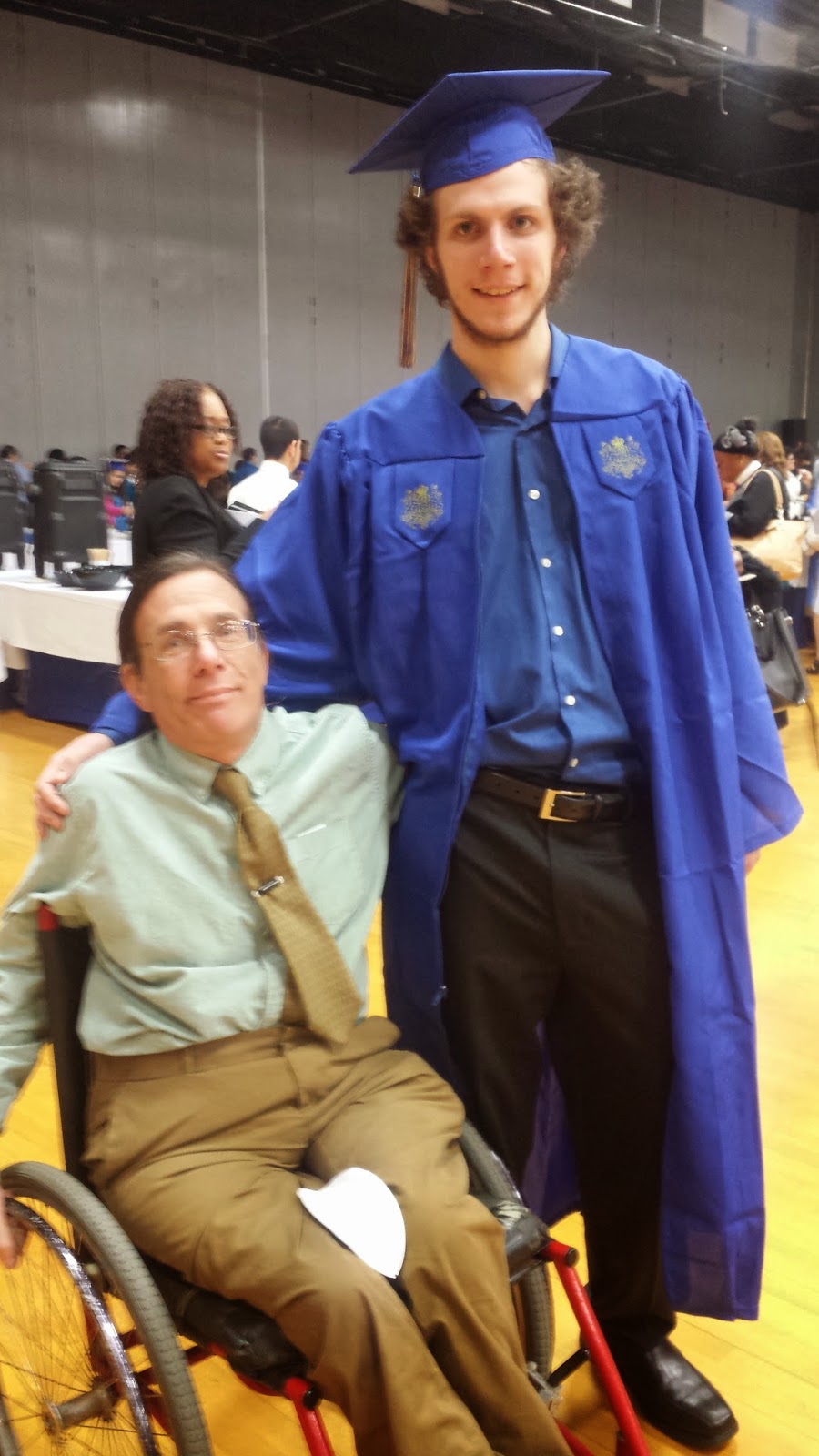
Exiled to Special Places is a line from Harriet McBryde Johnson’s classic essay the “Disability Gulag” published by the New York Times in 2003. It is a brilliant piece of writing. Johnson could be folksy, touching, legalistic, academic, charming, and pointed all in one short paragraph. I have been thinking of Johnson all week. Like many other people with a disability I live, work, and travel differently. Each and every time I travel or go to a large ceremonial event I am reminded I live in the metaphorical disability gulag: that is we are apart from others, typical others, the physical and social environment was built for. We people with a disability are thought to be powerless and dependent. Our presence is not wanted. Our bodies are a tragic reminder of the way life can go long. Hence institutions were built and staffed to care us—this is our history, one of social isolation, abuse, and segregation. We people with a disability are “special”. We are needy and society has a choice—out of the goodness of our collective hearts we will make the physical environment accessible; with the ever present proviso if it does not cost too much. Yes the disability gulag is a real place. It exists metaphorically and physically. Last week when I attended my son’s graduation from Hofstra University where I was put in a very real and demeaning gulag called “special needs seating”. 

Before I attended my son’s graduation ceremony I was worried. The information on the Hofstra website about commencement was badly dated. I emailed and called the commencement office. No reply. I asked my son to stop by the commencement office and ask about wheelchair access. The office location listed was incorrect. No one knew where or if a commencement office existed. I was tense and worried when I read the below:

Special Needs for Seating
David S. Mack Sports and Exhibition Complex Accessibility: This facility is wheelchair accessible on the main level and will be available for guests requiring this area. One family member may accompany those with special needs in this area during the ceremony. Upon entrance to the Arena, please contact an usher who will be happy to escort you.
It was my hope the above drop down tab from the commencement website page  was wrong. Based on 30+ years of experience, I assume when I read an antiquated statement about “special needs for seating" that I am screwed. Do not worry I told myself. Hofstra has a long legacy of being extremely progressive in disability rights and disability access. When I was a student at Hofstra (1978-1982) the professed goal of the university was to make the campus 100% accessible. I was a founding member of the Program for the Higher Education of the Disabled or PHED in 1978—an acronym I hated then and now. Have faith I told my son and ex-wife. Hofstra was at the forefront of disability access well before the ADA was conceived. They will not force us into a disability gulag. They will not enforce the discriminatory practice of one wheelchair, one “companion”.  There will be dispersed seating and we will have a host of options like all other who walk in the door. I was wrong. I was firmly placed in a real life disability gulag. 
was escorted to a wide aisle. I was sure to be bumped and jostled every time a person walked by. My view left much to be desired. 


Who gets to sit in the aisle for special seating? Me and other undesirables. Largely gray haired old ladies and people such as myself. I was stunned. I was not impressed. Is this where any human being would want to sit? This is not where i would want my mother or grand parents to sit. But I might be wrong--out of sight and out of mind. The legacy of exclusion thrives to this day. Dump the undesirables in the aisle. 

There is a speakers podium. I could see it if I bent over or moved back--far back into the wide aisle. Yes, the bar placement is perfectly placed to be at eye level. The ushers were polite but clueless. I told them this was unacceptable. They agreed. Nothing could be done. Sorry. No effort was made to help me. Help as in find a place for me and one companion to sit that did not have an obstructed view. I was furious but did not want to ruin the day for my son. I thought about leaving in protest but that would accomplish nothing. I sat and seethed in anger. What made me so angry was the fact that it would be very easy to provide dispersed special seating. There was an elevator that went to stage level and seating above me. Any number of areas would work well. There was plenty of space. The failure was not architectural. Not a single person put serious thought into inclusion. Special seating is a problem. The easy solution, the thoughtless solution, is to make two large areas on the main floor with an obstructed view and call it a day. Who cares? No one. Does it matter that Grandma cannot see the podium? No. Did anyone think perhaps a paralyzed man such as myself would be present whose son was graduating and would like to see him walk across the stage? No. Hofstra as an institution failed. They built a disability gulag. One and all should be ashamed. Do not give me the worn out excuse that the facility is old. The Mack Sports Complex was built in 1998--the post ADA era. No excuses here. None.  
As I sat and seethed I finally thought screw this. I navigated my way to the elevator and was going to sit where I wanted. A place where I could see my son walk across the stage and even see the podium where people would speak. I went down the elevator and as I did the the academic precession was organized and ready to march in. I moved to a good spot, in the back but with an unobstructed view. I was quickly told: 'You cannot sit here. We cannot accommodate your special needs". I replied "I am not a child, special needs seating is unacceptable and you will accommodate me here. My son is graduating".  The social interaction was tense. The ceremony was about to begin. A scene could erupt. I suggested that I could accost the President of the university for his opinion as he was about 15 few feet away. The usher knew I was not going to move. I was an uppity cripple and the timing was bad. The show had to start and the easy way to solve the problem, my existence, was to do nothing. The usher did nothing. 
As I sat and listened to the speakers who were mercifully brief I thought about the unwanted above me. My people were getting screwed. Needlessly screwed too. I thought of the slogan "nothing about us without us" and "our home not nursing homes". I thought of Johnson who wrote:
We know better. Integrated into communities, we ride the city bus or our own cars instead of medical transportation. We enjoy friends instead of recreational therapy. We get our food from supermarkets instead of from dietitians. We go to work instead of to day programs. Our needs become less "special" and more like the ordinary needs that are routinely met in society. In freedom, we can do our bit to meet the needs of others. We might prove too valuable to be put away.
Despite 40 years of progressive legislation aimed at empowering people with a disability remain disenfranchised. I am sure not a single person that attended the graduation ceremony that walked by special needs seating gave it a second thought. Why are so many elderly people and wheelchair users jammed into two spots? The answer is simple: it is the symbolic representation of a century of oppression. 
As I made a very long drive home yesterday I was torn. I am weary of access always being a problem. Nothing is ever simple. Not even graduation at a university such as Hofstra that has an outstanding reputation in terms of disability rights. I grew depressed this morning util I took a short break and discovered I am not a lone. I am not the lone voice in the wilderness crying out. Stephen Kuusisto wrote: 
if you were a person with a disability at Iowa’s commencement and you desired a seat, perhaps with your family, you were out of luck. One of the reasons I left the U of Iowa was the institutions general and ubiquitous unconcern for people with disabilities. The disability seating in the “Carver Hawkeye Arena” is pre-ADA seating, at the top of the stadium; so far from the action you might as well stay home... Hofstra’s commencement was every bit as disgraceful as Iowa’s arrangement. Now this isn’t a scientific sampling. Two parents with disabilities, two campuses, but ask yourself about academic culture and disability. Iowa’s student services office for disabilities is located in the basement of a dormitory where people with wheelchairs can’t in fact “get out” if there’s a power failure. The architectural and administrative message couldn’t be clearer: disability is a ghetto; its marginalized; its not important for the able bodied general administrative population to think about. Link: http://www.stephenkuusisto.com/uncategorized/disability-and-the-end-of-another-academic-year
Shame on Iowa. Shame on Hofstra. Shame on academia for being just as discriminatory as mainstream society. I expect much more from Ivory Tower culture. Sadly, I am routinely disappointed. But I refuse to to be silent. I will not be meek. And I will not let this issue drop. I am going rattle some cages at Hofstra next week. I did not let the lack of access ruin my son's day. I am proud and chuckle that somewhere along the line I spawned an adult I am proud of my boy. 

Thursday, May 15, 2014

Why I love Writing at Bad Cripple

This blog is a labor of love. Given the degree to which most people with a disability are disenfranchised they need access to blogs such as mine. Need is a powerful word and I believe it is apt. I have a very wide readership now and write so that an average person can understand larger points made by scholars. I do my best to solidly ground what I write in a practical day to day way that any person with a disability can relate to. My intent is to merge scholarship and activism in large part because I refuse to go down the bioethics or disability studies rabbit hole. This is not a knock against either field, both are rigorous fields of study in academia I enjoy.

A few months ago I was forced to start aggressively moderating comments. Too many comments I was getting were nothing more than vicious diatribes. I have no idea why there was a striking increase of such comments but it reflects my life long ability to piss people off. The most recent group of people to be upset with me are Catholic bioethicists and Catholic commentators. What did I do? I published an article about sexuality and an experience I had as a young man. I thought my essay was ancient history but I knew it would generate a buzz and buzz it did. It is my hope this buzz will die down. Thus it was with trepidation that I read Jennifer Fritz comment on one of my recent posts.  Link: http://www.patheos.com/blogs/jenniferfitz/2014/05/how-not-to-do-religion/  Apparently Fritz is a long time reader and I must say I burst out laughing at the last line of  Fritz's "How Not to Do Religion".

Edited for a strong language warning on the link.  W.P. is many things, but choir boy he is not.  Or rather, he’s like choir boys really are, not like their mothers imagine they are. 

I want one and all to know I was never a choir boy. Not with my voice and utter lack of musical ability. I was instead an alter boy! Yes, as a bipedal child I was an alter boy. Let that one stick in your craw and ruminate over.  One last point, Fritz is correct choir boys and alter boys are nothing like their mothers imagine them. Golly, I hope my mother is not reading this!

Wednesday, May 14, 2014

An ode to Kate

I love my black lab Kate.  She is an amazing dog I love with all my heart and soul. She has never hurt me. She has not broken my heart. She is dedicated. She is loyal in the extreme. She makes me laugh daily.  She has proven to be remarkably adaptive. In fact she experienced her first foray into Midtown Manhattan and she not only survived but thrived. However, our relationship did not get off to the best start. Let me explain because it was all my fault.

I got Kate from a great breeder in New York.  I was all on board for a labrador. My big yellow lab Burt that grew up with my son was getting old. I guessed Burt was a year or two away from death. I had spoken to the vet and many other dog owners and all stated raising a puppy was easier with another dog in the house. They were correct. Kate was a gentle and loving puppy in contrast to Burt who was a nightmare puppy from hell. He did not cry when left alone. He howled. Looking back he experienced acute separation anxiety. Burt though turned out to be the most loyal animal that ever existed. He was not very smart but he had loyalty embedded in his DNA. My son and I joke if we asked Burt to jump off a cliff he would do so without hesitation. If we asked Kate to do the same she would look at us like we were nuts. Both labs but very different personalities and approach to life.

The problem with Kate is that I dislike raising puppies. In other words Kate was fine. The so called problem rested with me. In raising Kate I learned I like other people's puppies. I get to laugh and coo over how cute they are and leave the work to the owner. Kate was cute in the extreme and I do love her puppy pictures. She came to me at eight weeks and weighed under 10 pounds. She melted my heart. She is 11 years old now and a slender 62 pounds. She has not slowed down one iota as she has aged. She has been described by a friend as a pepper pot. Another person I once knew called her jingle dog.

My one and only fond memory of her puppyhood was watching her interact with Burt. Burt loved to play catch but as he approached the end of life he could not run any more. When I would throw a ball as Burt aged the distances got shorter and shorter. This made Burt sad. Enter Kate. I would throw the ball as far as I could and down a sharp hill. Burt would amble away from me to the edge of my driveway and watch Kate speed by at warp speed. She would retrieve the ball and rather than give it to me she would drop the ball next to Burt. Burt's tail would go crazy as he brought he ball back to me. He and Kate loved this game. I did too. We played it every day. To me this game was adpatation at its finest. It made me proud too. In fact when I tell this story I get teary eyed. I have thought a lot about Kate, Burt, friendships, love, and loneliness. I have tried to find some comfort in who I am as I age. And aging I am. My son told me his roommate saw a picture of me online and thought I looked distinguished. Shit, I replied that is another word for old. Way old.

My stay in New York City obviously stoked a flood of forgotten memories and prompted much self reflection. I lived in the city as a young married man. My son was born in New York City. My 20s and early 30s were filled with many milestones. Life was ahead of me. Fast forward to today.  Life has not gone according to plan. I doubt life ever goes as one expects but I seem to struggle more than others. Yet I also know and will always acknowledge I am exceptionally lucky. I have had rock solid family support. I have forged deep and meaningful friendships. I enjoy speaking at various universities. I love to teach college students. I enjoy my work immensely. I have had a good life. A good atypical life. And frankly the atypical part of my life makes me angry. The issues I encounter are needless: specifically travel, mass transportation, and housing nightmares. All are fraught with bias, bigotry, and a gross lack of access. The mere fact I have not let this troika kill my spirit is satisfying by itself. The lack of access, culturally and physically, remains deeply embedded in American society. Worse, very few people care and I often find myself stating no one gives a shit. I state this without rancor. It is just a fact. Bottom line: I live in a hostile world in which my presence alone  is a problem. Want a hotel room in New York City? Be ready to make many phone calls and hope what is said and promised are reality. Want to rent a car? Be prepared to make many phone calls and know despite the energy and time expended the odds are 50/50 a car will be present. Want to move to Syracuse? Know that 99% of places for rent are not accessible. Ask a real estate agent for assistance or approach a building and inquire about an accessible apartment? Expect sorry I cannot help or there is a three to five year waiting list for an accessible apartment. Effort expended on the part of others? Zero. Interest in why no accessible housing exists--zero.  So yes I am mad. I am a bad cripple for good reason. In comparison to the bipedal people the social and physical environment is designed for Kate is looking pretty good. She cares and loves me.

Monday, May 12, 2014

On Enduring

Recently I was cleaning out a file draw and found an essay Arthur Kleinman published in the Annals of Internal Medicine circa 1978. Far ahead of his time, Kleinman argued traditional biomedical solutions in health care were no longer effective. The focus of modern medicine is squarely focused on disease and healing. An abnormality is identified, a treatment program created with a single goal: cure the disease or physical deficit. This approach works—but not all the time. What happens when no cure exists? In my experience one enters into a liminal state or as Victor Tuner called it “betwixst and between”. A person such as myself who is paralyzed yet healthy symbolically represents the limits of medical care. I failed to be cured. As a result, my existence is deeply unsettling in most health care settings. Deeply stigmatized I am. 

When clinicians deal with a healthy person with a disability they typically respond in two ways: some become frustrated a cure does not exist and simply state “there is nothing more I can do for you”. This is counter productive if not demeaning. I have heard these words many times. I translate this statement to mean go away. You have a spoiled identity. Some clinicians simply state “I do not treat patients with severe disabilities. You should see a specialist”. Other clinicians fall into disease management mode. The focus is not on cure but maintaining current levels of function. Disability for both clinician and his or her “patient” is bad. Very bad in fact. So bad no avenue or course of treatment is left untried. I call these people “professional patients”. Another group exists: cure junkies. These people reject disability and they are preyed upon by physicians who are ever so close to cure and dangle this carrot in front of people with a disability who fail to adapt to a bodily deficit such spinal cord injury.

As I read Kleinman’s essay I thought of my recent post in which I suggested hospice care was a valuable way to approach end of life issues. Quite a few friends contacted me who did not like my suggestion. Their serious reservations have merit. Health care disparities for people with disabilities are wide spread. Many people with a disability at the end of life are not over treated as most fear but rather  under treated. Stories abound about how clinicians negatively assess “quality of life” for a person with a disability. Many people with a disability seeking basic health care are encouraged to die. The perception is they are needlessly suffering. Thus it is not  uncommon to hear the following: “We can make you comfortable with an alternative and less aggressive treatment protocol.” The so called alternative is death. The problem as I perceive it is that clinicians have a very narrow and insular perception of disease, illness and disability. Kleinman defined disease as “abnormalities in the structure and function of body organs and systems”. Clinicians identify what is physically wrong with the body. Illness in contrast is what a patient experiences when they are sick—and all disabled people are thought to be sick in some way. Remember this was written in 1978. Illness and disability were solidly linked together. I would like to believe we as a society have evolved and developed a more nuanced understanding of disability. Sadly, this is overly optimistic. Stigma, social isolation, poverty, and unemployment remain the norm for people with a disability. 

The lasting problem with life post disability is that health care professionals routinely ignore all issues that inevitably arise outside the confines of the institution in which they work. It is as though the larger world does not exist. No support or dissent is expressed when discharge options for a person are far less than ideal if not deadly. Discharage planners are powerless and not effective. For example, what good is the advice of a clinician who tells a homeless man or woman with a badly infected foot to keep the limb elevated, take anti-biotics, and change the dressing twice a day? The clinician might as well suggest a trip to Mars. Utterly absent is any thought of what Kleinman identified as the experience of living with an illness. Kleinman’s dated language is now easily framed as disability narrative. Such narratives are regularly dismissed by health care professionals as “anecdotal”. This drive me crazy. The memoirs produced by people with a disability are diverse and of the highest quality. Few if any are widely read among health care professionals. The result is ignorance of disability abounds. Much is known about diverse physical deficits but much negativity is associated with atypical bodies and people with a disability. Worse, disability is always perceived to be “bad”, an unfortunate departure from the norm. Well, when compared to typical bodies a person such as myself will fail the comparison test every single time. Lost is the knowledge gained from being atypical. We people with a disability often go through the medical mill. We learn much through our too often painful experiences. That is physical pain and the pain caused by bigotry and ignorance. 

Let me return to Kleinman. In Lancet he recently wrote an essay “How We Endure”.

Poverty, joblessness, migration, and other social realities of our era, along with the experience of major natural disasters, nonetheless revivify for many the importance of striving to endure. For professionals who complain of burn-out and for family caregivers who exhaust their own inner resources, for those involved in humanitarian assistance, and for many other people faced with unrelenting hardship, and physical and emotional burdens, it might prove useful to reconsider the value of enduring in human experience. Instead of asking why patients, caregivers, physicians, aid workers, and other health professionals burn out, suppose we ask how they endure? And I mean by endure withstand, live through, put up with, and suffer. I do not mean the currently fashionable and superficially optimistic idea of “resilience” as denoting a return to robust health and happiness. Those who have struggled in the darkness of their own pain or loss, or that of patients and loved ones, know that these experiences, even when left behind, leave traces that may be only remembered viscerally but shape their lives beyond.

I can comfortably state that I have endured much pain and suffering in my life. I had three massive surgeries, many lesser surgeries, prolonged hospitalizations (as in months on end), I was bed bound for almost a year. While I do not recommend what I experienced, through it all I matured and became a better person. I endured as Kleinman suggested with the knowledge I was not so resilient that I would return to the norm. We need to listen to those willing and able to endure. We need to listen to parents of infants born with profound disabilities. We need to listen to those parents that take of children with profound disabilities. we need to listen to those that care for elderly parents. We need to listen to people with disabilities such as myself. We need to listen to all those that endure over the course of the life cycle.  If we do this all will benefit. But we need to listen very carefully. We need to pay close attention to the words and phrases we use: patient centered care, quality of life, end of life issues, autonomy, medical futility etc. When I hear physicians utter those words I worry. As Ben Wilfond observed a decade ago the phrases above are not accurate clinical descriptions and instead serve to convey a normative view about the quality of life of others. It enables clinicians to characterize the use of anti-biotics as “aggressive” when treating a severely disabled person or a person near the end of their life when in fact use of such antibiotics would be typical be considered routine. In short, using the terms above hides what is really being judged: the quality of life of people who are different. This is a social problem all the medication in the world cannot cure. 

Sunday, May 11, 2014

A Reply to "What Should We Do About Severely Impaired Babies".


In the Kingston Whig I read an editorial by Udo Schuklenk who teaches bioethics at Queen’s University. Schuklenk’s, “What Should We do About Severely Impaired babies”? made me lose sleep last night. Link: http://www.thewhig.com/2014/05/09/what-should-we-do-about-severely-impaired-newborns Utilitarianism has its its hooks into the health industrial complex, mainstream press, and contemporary popular culture. Access to health care is increasingly based on the lives we perceive as being worth living. This is a dangerous if not a deadly line of thought for vulnerable populations. I am one of those people whose life is not worth living in the estimation of many—paging Peter Singer at Princeton University and all those at the the University of Oxford Uehiro Centre for Practical Ethics. So whose life lacks value? Severely disabled infants, elderly people with Alzheimer’s Disease, those with a profound cognitive deficits, vent dependent quadriplegics, and many other costly and undesirable human beings. This makes me shudder. It is sobering and distressing to know my existence is unwanted. It is frightening to know some, highly educated others, think my life has no value and would like to end my suffering. 
It is does not take a great deal of insight to establish whose life is worth living. All those that are productive and contribute to society in a very narrow sense have value: bipedal people with typical cognition who are employed and supposedly fully autonomous. What utilitarianism fosters is a business model of life or bottom line approach that is essentially heartless, unimaginative, and draconian. Compassion in health care? Forget it. All hail modern medical science and expensive high tech diagnostic tools. Of course the proviso is only those we value have access high priced high profit medical technology. Worse, we can use that technology to prevent expensive, oops, I mean severely disabled infants from existing. Schuklenk celebrates prenatal testing.
Every year a small number of fetuses are carried to term who have no reasonable chance of living a life worth living. They are so severely impaired that they will live a miserable, short life until they eventually expire. The good news is that, courtesy of prenatal screening, only few such births take place and the numbers are decreasing. We have some data from the Netherlands, where a few hundred out of about 200,000 newborns annually tend to fall into this category.
What Schuklenk is celebrating is a new form Eugenics. In stating this I just lost my bioethicists and neonatology readership. When I use the E word bioethicists and neonatologists shut down. These heath care professionals believe my views are offensive and unbalanced. Surely I must be a religious fundamentalist whose faith and adherence to religious doctrine clouds my thought. Worse, some neonatologists will furiously assert “I am not  Nazi” when asked probing ethical questions. There is no effort to look beyond the narrow confines of the institution and NICU where they ply their trade. This enables a scholar such as Schuklenk to wonder:
Would it make much sense to undertake significant surgery with the – unlikely but possible – result that the newborn might live a miserable life for another year or two before his impairment eventually catches up with him and kills him? Should we withdraw nutrition and hydration while providing palliative care so that he doesn’t suffer? Should we actively terminate his life to end his nightmare quickly and painlessly, as well as that of his parents? 
I find the above stunning. Schuklenk is a widely published philosopher and I cannot help but ask what if any experience does he have among those that live and thrive with severe disabilities. Has he ever talked to a vent dependent quadriplegic? Spent time at a group home?  Talked to people who care for a beloved elderly parent with dementia? Has he ever thought about the contribution those with a profound disability can make to society? I suspect the answer to all these questions is a resounding no. This is in part why I find utilitarian philosophers dangerous. They have not seen the power and creativity of the disability experience. They could not grasp that my entire conception of disability radically changed because of my exposure to a vibrant, funny, and profoundly disabled young woman who would be deemed non verbal by neurologists. They do not see what Eva Kittay calls emotional labor. They do not get why I am comfortable using the word Eugenics. You see when I was an undergraduate the most common person using a wheelchair was a person with spina bifida. I have not met a man or woman with spina bifida in a decade. Unlike Schuklenk I do not celebrate prenatal testing. I cannot celebrate the 93% termination rate when spina bifida is identified prenatally. The decision a woman makes to terminate a pregnancy is not done in a social vacuum. If 93% of women terminate such a pregnancy it takes a lot of intestinal fortitude to reject what virtually all women do in a comparable situation. I call this the illusion of choice. 

What Schuklenk fails to consider is that life with a disability, even the most severe of disabilities contains great value. Like many other scholars, he cannot make the required intellectual leap in logic. Disability is bad. Disability must be eradicated. Hence he can reasonably argue that health care professionals must give up the sanctity of life doctrine and replace it with a quality-of-life ethic. 

There is no point in maintaining human life for the sake of it if that human life cannot enjoy a moment of its existence and is trapped in a never-ending cycle of immense pain and suffering. A quality-of-life ethics would not merely ask ‘do you exist’, but ‘do you have a life worth living?’, or ‘will you have a life worth living?’
What is conveniently overlooked is the long a dismal history associated with disability. When it comes to disability—the social and physical implications—most will think a person such as myself has a very poor “quality of life ethic.”  People often assume I am unemployed and asexual. People are often taken aback I have a PhD from Columbia University. People are shocked to learn I have a son, was married and divorced. In fact I am routinely asked “are you the biological father” or "how long after your son was born were you paralyzed".  Essentially, the typical is thought to be beyond my grasp. What people see is all that I cannot do. First and foremost is my inability to walk. In response I routinely joke that bipedalism is grossly over rated. Behind this joke, a pointed joke, few get the fact quality of life ethic does not include virtually all people with a disability. This is wrong and the consequences are built upon 100 years of being a marginalized other.  

I find the cultural response to disability disheartening and the power imbalance between myself, bioethicists and health care professionals to be profound. Barbara Farlow who brought the editorial by Schuklenk to my attention is correct when she asserted that the mere fact the prestigious American Thoracic Society entertained such a discussion is deeply problematic. Worse, the argument against Schuklenk was framed strictly within religious terms and utilized an amorphous concept of dignity. This I cannot help but to conclude is not just misleading but disingenuous—a straw man approach to debating.

The editorial by Schuklenk reminded me of Harriet McBryde Johnson’s famous debate with Peter Singer. Her enlightening exchange brought Johnson into the national spot light. It helped that she whipped Singer in her public debate with him. An unabashed atheist Johnson, dismissed religious claims about the sanctity of life. She did not invoke the slippery slope. Instead, she asserted her humanity. How dare you or anyone else question or subvert the quality of my life. I am a human being and no human should be forced to defend their humanity, There is no such thing as a nonperson. So called nonpersons or those that think certain thresholds must be obtained to be considered human are missing a very basic aspect of humanity—disability and difference is a natural part of the human experience. It is in fact good for the human species. And it has been ever present. It need not be eradicated.

After more than 40 years of progressive legislation designed to empower people with a disability, the battle for equal rights remains very much an uphill battle. For Harriet McBryde Johnson, myself and all those with a disability that have the gall to assert their humanity we take our lives seriously. We value our existence. She wrote that Singer:

insisted he doesn’t want to kill me. He simply thinks it would have been better, all things considered, to have given my parents the option of killing the baby I once was, and to let other parents kill similar babies as they come along, and thereby avoid the suffering that coms with lives like mine and satisfy the reasonable preferences of parents for a different kind of child. It has nothing to do with me. I should not feel threatened. Whenever I try to wrap my head around his tight syllogisms, my brain gets so freed it’s—almost fun. Mercy! Its like Alice in Wonderland. No, having leapt down the rabbit hole and landed in this place, I find things becoming curiouser and curiouser. 

The fact is the presence or absence of a disability provides no indication about a human being’s quality of life. I know more than a few people with no disability whose quality of life is less than ideal. I know many people with a disability whose quality of life is envious. Life is not about thresholds we must reach but rather about social inter connectedness and doing the best we as human beings can do.  

Friday, May 9, 2014

Loneliness, Autonomy, Fear and Tim Bowers

Every person I have met with a disability routinely feels lonely. I am not referring to typical loneliness most feel at some point in their life. I refer to loneliness in a deeply painful way that makes your soul and bones ache. This is the sort of loneliness I feel. It is the loneliness most people with a disability feel on a regular basis. I know I do. I know there are days I am weary. I simply cannot face a hostile world. I cannot leave my home because I do not have the psychic strength to deal with the fact my existence is not welcome. I cannot deal with the routine harassment or stares or the mothers who yank their kids arm when they see and tell their child "watch out for that wheelchair". Well done, mom. A lesson has been learned: fear the human being using a wheelchair. 

I am not particularly lonely today. Yet I want to write about loneliness because my friend Stephen Kuusisto at Planet of the Blind astutely wrote that he belongs to "fellowship of lonesome people". Link: http://www.planet-of-the-blind.com/2014/05/confessions-of-a-lonesome-disabled-and-autonomous-man.html Amen brother! Kuusisto contends mainstream lives, typical lives, are the "products of foundation". Kuusisto notes: 

The underpinning or “base” I’m referring to results from autonomy. Its a Greek word. It refers to the capacity of a rational individual to make informed, un-coerced decisions. People who grow up in fear don’t necessarily develop such capacities. Loneliness is a byproduct of fear. I don’t know how to be among you, it says. If I’m lucky enough to be among you, I must hide who I am. 

I never thought that loneliness was a by product of fear. Fearful I am. I know I am without a doubt very lucky. I had great parents. I had the foundation Kuusisto refers to growing up. I had a good foundation for much of my life. But I have always struggled with fear. I am a fearful man. I am fearful because I know the bipedal hordes that surround me consider my existence sad, an affront really, and most wish I did not exist. I am the symbolic representation of all that can wrong. Kuusisto is correct when he asserts:

Autonomy deficiency is the biggest problem faced by people with disabilities. We don’t talk about it enough. Instead we say “self-advocacy” —as in Joey needs to learn how to be a self-advocate...You can’t be a self-advocate, or a member of a community, or even a decent dog owner, without having achieved the capacity to make informed and healthy decisions.
Kuusisto is correct--people with a disability have an autonomy deficiency. I would not use the same phrase however. I suggest we people with a disability are given the illusion of autonomy so that those around us who despise our existence feel better when our human rights are violated. We are not bigots, we are honoring autonomy. In a word, bull. Tim Bowers was given the illusion of autonomy. Last Fall while hunting Bowers had a devastating cervical spinal cord injury. At family request, he was taken out of a medically induced coma and asked if wanted to live by his family and doctors. Bowers decided life as a vent dependent quadriplegic was not for him. He chose to die. Bowers decision was hailed as a victory for autonomy. Bioethicists crowed his death while sad was evidence bioethics has made a major contribution to patient centered care. Bowers decided for himself that he wanted to die. Peter Schwartz, Indiana University Center for Bioethics stated: The case of Tim Bowers is truly a triumph of autonomy, a case where he had a chance to make a decision.  In addition, people who knew him have asserted that he was consistent in never wanting to live in a wheelchair.  Link: http://iucb.wordpress.com/2013/11/16/tragedy-and-choice/ 

I find it hard to wrap my brain around the celebration of Bowers death albeit a sad one of supposed choice and tragedy. Bowers death was tragic. But choice? Autonomy? No. Bowers and his family did not make an informed decision. They made a decision based on fear and stunning ignorance about the quality of life for a man post spinal cord injury. All point to the fact Bowers, before his injury, had stated he would not want to live life in a wheelchair.  Let me ask this: have you ever met a person that desired to be paralyzed and use a wheelchair? Many people speculate what life post spinal cord injury is like. All come away with a negative assessment and use a throw away line like "I would never want to live in a wheelchair".  Do these people ever ask a paralyzed person what life is like post injury. Never.  If they did they would not like the answer. For example, I would state life is sweet pre and post paralysis. I like my body very much. It serves me well. In fact I would not change a thing about my life. This is the answer people do not want to hear. They want tragedy. They want sorrow. They want me and others with a disability to wail and be full of sorrow. Why is this? Kuusisto noted that:

Now everyone loves autonomy: religious zealots, ideologues, business men, politicians, generals and admirals—all wave the autonomy flag. This is because “informed” (for them) means willing. In turn they get to decide what’s healthy for you. 

This is why I am so fearful. I fear the unknown they. I truly fear any health care system dominated by people who know nothing about life with a disability. Good people in Indiana  legally killed a man. There I said it. The physicians and family of Tim Bowers needlessly killed him. They couched the decision in emotional rhetoric that obscures the real issue: Bowers was victim of a compassionate and legal homicide. In stating this I am an extremist.  Bioethicists will shut down and refuse to engage. Bowers family will cry and scream in out rage. We loved our son. I loved my brother. How dare you! I dare to state the painful and hurtful truth because I do not want others to needlessly die.  I do not want to die. All the wrong questions were asked at the time Bowers was injured. No one speculated about what he could do. No asked how can he be autonomous? No one asked how can he hold his soon to be born child? No one asked about the future? No one reached out to others with a similar injury leading a good life.  Again, this is why I am fearful. People such as Bowers that die are applauded. People that choose to live are expected to demonstrate they remain human. They must demonstrate their life is worth living.  They are, in a capitalist society, deemed an economic drain  not physically capable of making a contribution to society. Thus I would observe as many others have it is far easier to die than it is to live. But my oh my life is sweet. I would not change a thing--including paralysis. A conclusion I suspect Bowers would have come to had he been given a chance.