Search This Blog

Friday, June 20, 2014

Clarion Inn at Syracuse: Incompetence Abounds

On Wednesday my son Tom and I took a quick trip to Syracuse. I wanted to show Tom the Syracuse University campus as well as where I will be living when I move. I did not want to stay at the Red Roof Inn where I stayed many times last academic year. I wanted a slightly better environment. To this end I reserved a room at the Clarion Hotel in Syracuse. The on line reviews were largely positive, it was not too expensive, and had a free continental breakfast for my son's bottomless stomach.  Better yet I was able to book a room that had two beds and a roll in shower. Here is a screen shot of the Clarion Inn reservation information:


The screen shot is poor quality and likely cannot be read. It states in part "2 double beds accessible. Also included mobility and hearing accessible, Roll in Shower, ground floor".  Perfect I thought. The days of sharing a bed with my son are long gone. We left for Syracuse very early. We arrived in time for lunch and I had a great time showing him around campus.  I also took him to Wegmans and he was massively impressed. In short we had a great time and by late afternoon were ready to check into the Clarion Inn. The second I walked in the door I knew we were in trouble. The two employees at the desk looked at me with trepidation. People who use a wheelchair and travel know this look. It is as though you have a bomb on your lap and the employees are fearful it will explode at any second. I identified myself and the employee at the desk ignored me. After I told her my name she looked at Tom and asked him for a credit card. Tom looked at her, then looked at me and remained mute. I put on my stone face and handed over my credit card. She ran the charge and did whatever needed to be down to check us in. She then tried to hand my credit card back to Tom. He did not reach for it and stepped back making it impossible to reach him. I put my hand up and wondered when did I catch the plague. I put the credit card away and the employee then tried to hand Tom the keys and directions to the room. We had driven around the building prior to entering the lobby and noted multiple entrances--most of which inaccessible. I asks very clearly what entrance was accessible and was annoyed in the extreme.

I navigate to the entrance on foot and Tom drove the car around the building. We arrived at the entrance at the same time. There were four steps to enter the building. We both turn around and head back to the check in desk. I am not impressed. The employee that continually tried to engage Tom is gone. A very young employee is alone at the desk. She has absolutely no clue how to help  me. I am quick to ask for the manager at this point.  Two employees emerge from the back. Neither employee identifies himself or herself as being a manager.  There are now three employees at the desk and all appear stunned I am present. It is as though a Martian has just entered the lobby. I was a problem that was solved a few minutes earlier. My presence was clearly unwanted. A man starts to furiously type away at the key board and a discussion ensues about which rooms and what entrance is accessible. No one has a clue and massive confusion reigns supreme. I am angry; however I do not raise my voice or change its tone. My son was furious and told me he would wait outside. I wait as more keys are struck and I am told there is an accessible room but there is no roll in shower. This is contradicted by another employee who says there is a roll in shower but it has only a king bed. No one is sure where the accessible entrance is. My confidence in anything I am told reaches zero.

I ask again about the accessible entrance and two employees contradict each other when they answer at the same time. They then contradict each other about the room number and location of the supposedly accessible room. I give up. At least 15 to 30 minutes after I arrived I cancel my reservation and walk out in frustration. We did not see a room or the inside of the hotel. No apology is offered. Off the Red Roof Inn we go. Upon arrival we are warmly welcomed and the manger jokes that "my room is available". She throws in a AAA discount, gives my black lab Kate a bone and offers her some water. Check in takes all of three minutes. The manager addresses me at all times. She has ignored my son who stands at a respectful distance. When ready to go to the room I introduce her to my son. They great each other warmly and off we go. I am routinely impressed by the Red Roof Inn. As always, the shower head is down in the room that has, gasp, a roll in shower! The staff in every Red Roof Inn I have stayed in knows the location and features of the accessible room instantly. Check is smooth and simple--normal if you will. In fact I almost feel like a typical bipedal traveler.

In the last year I have traveled a great deal. I have stayed at high end hotels. I have stayed at some real iffy motels in questionable neighborhoods. Generally speaking I have had far more positive experiences at budget motels over high end hotels. Obviously exceptions exist. I would speculate this is a numbers game--a matter of basic economics. People with a disability are in overwhelming numbers poor. The few that can afford to travel surely stay in budget accommodations. High end hotels without question do not get nearly as many visitors with a disability. As a result, budget motels like the Red Roof Inn are extremely responsive and familiar with accessibility. Other chains I avoid. The Clarion Inn is at the top of that list now.  I know certain hotels to avoid--some of them are top notch hotels. The Grand Hyatt and the high end Marriott for example are typically terrible in terms of access and the reservation process is time consuming.

In spite of the needless trouble we encountered we had a great trip. My son was relieved to see that I am not going to be living in a hovel. He saw the town I am living near and was impressed. The surrounding area is gorgeous and I am literally living on a lake a mere 30 minutes from the Syracuse campus. Here is proof the location the lake I will be I will be living next to is lovely.


The highlight of our trip took place in Roscoe, New York on our way home. We visited Prohibition Distillery that sold bourbon and vodka. We ate a sub made at the local sandwich shop that was delicious. Better yet, we ate outside and Kate ate our bread scraps. We then went to the distillery and had a sampling at the that we shared. My son had bourbon, I had the vodka. Wow. Best vodka I have ever had and the bottle design was cool. Such is my life. Never ordinary and many highs and lows. When we got home I can assure my readers I had a stiff drink--in fact I will confess I had more than one and went to bed a happy man.


Monday, June 16, 2014

Chronicle of Higher Education Story Features Me on the Lack of Access at Academic Conferences

In the Chronicle of Higher Education a story appears about the lack of access at academic conferences. Unfortunately the article is behind a firewall and is only accessible to subscribers. The Chronicle of Higher Education reporter that wrote the story was kind enough to provide the following link that will provide access to the story for the next 24 hours. Link: http://chronicle.com/article/Indifference-Toward-Disabled/147149/?key=S2J7KQNoMixHMCowMTpLMTkGPHxvMhh7ZnUebSwnbllWFw==  Attending an academic conference is never easy for a person with a disability. All academic conference are expensive and are to an extent designed for privileged academics. Conferences routinely involve travel which by itself is highly problematic for people with disability. Airlines are notoriously bad when it comes to the most basic reasonable accommodations.  Thus even before a scholar with a disability enters the conference hotel he or she has already gone through a gauntlet simply to attend. I for one often arrive tired, hungry and pissed off because of travel related hassles. This says nothing of the utter lack of information provided by hotels and academic organizers about access in a city I have likely never visited. Once settled in at the conference hotel I then get to insure the room I will speak in is accessible--never a sure thing.

Last night I was speaking with my son about the Chronicle of Higher Education story and thought I am to a degree privileged. I am an established scholar and when the lack of access goes from difficult to impossible I know people that I can call who will help. But what I wonder happens to a graduate student or a recently minted PhD trying to jump start his or her career? They will assuredly encounter barriers that cannot be eliminated. And this is exactly why I advocate for myself. Sure it is to an extent selfish. But the reality is I am far more concerned about the person with a disability that will follow me in the years to come. I do not want that scholar to encounter the same barriers I did. It is not about the present for me but the future. It is my hope that future is one in which scholars with a disability do not experienced discrimination or encounter needless barriers.

Saturday, June 14, 2014

Walking is Over Rated

I never think about walking. Not in my dreams nor when I am awake. Walking has no relevance to my life. I do not miss walking one iota. In fact I think more about the way I push my wheelchair and use the gears on my handcycle. If people ask me about walking, and strangers often do, I emphatically state walking is over rated. This is a sure fire way to undermine any discussion of typical ambulation. When I shut down this discussion I also eliminate any reference to the myriad of ways in which the mainstream media glorifies walking. Here I refer to the silly, ineffective, impractical and expensive ways bipedal people dream of making paralyzed people walk again. Believe me when I state we paralyzed people do not think nor care about walking. It is a discussion and thought that does not enter our minds.  If you do not believe me I suggest you visit the website Walking is Over Rated. Link: http://www.walkingisoverrated.org  This is not the best website--great title but the content is spotty and dated. However it does get the point across--walking is over rated. 

In an effort to put bipedal people in their place I read with delight a post by Red Nicholson entitled "Why the Obsession with Walking?" Link: http://attitudelive.com/blog/red-nicholson/opinion-why-obsession-walking Nicholson correctly asserts the obsession bipedal have for getting paralyzed people walking has reached a fever pitch recently.  I watched and laughed when I saw the World Cup exhibition that had a paralyzed man strapped into an exoskeleton kick a soccer ball. This was anti climatic in the extreme and thankfully was quickly dismissed by the mainstream media. This came as a relief to me. The exoskeleton is the latest and most expensive useless means to get paralyzed people to walk again. When I read stories about the exoskeleton I cringe. Nicholson hits the nail on the head when he wrote: 

Believe me when I say this: my wheelchair is a very capable tool and to be honest, the last thing I want is to be strapped to a District 9-esque robot and become a puppet in some corporation’s half-baked execution of an obsession with making the non-walkers walk again. Because the trouble with this narrative, if it wasn’t already obvious, is that the journalists who write these stories are unwittingly invalidating a unique way of life for millions of people around the globe who are really happy with their wheelchairs. The implicit message from the media seems to be, "Wheelchairs suck! Walk in this robot instead!

This is the image we are left with: 


Nicholson correctly notes the problem with such images and inventions such as the exoskeleton is that people who use a wheelchair do not dream or yearn to walk. We are too busy with our lives. Work, family, marriage, child rearing and friends occupy our time and thoughts. Worse, when we paralyzed people do not share or express an interest in the obsession with walking there can be a severe backlash.  We are thought to be bitter party poopers or delusional and perhaps mental ill. Surely everyone wants to walk! Sorry, but no. I do not want to walk. I do not miss walking. 

Nicholson concludes that he has: 

no more desire to be strapped to a robot than I do to go swimming with great white sharks. In truth my life as a wheelchair-user is a very good one. I do a lot of great things and know a lot of great people. So hey, able-bodied media: quit making me feel like wheelchairs are a shitty, sub-par option. Stop beating your exoskeleton drum. And most of all, let go of your obsession with walking, because it’s totally overrated. 

I would like to second Nicholson's observation and take the critique one step further (pun intended). The exoskeleton is inherently misleading and its benefit to paralyzed people has not been established. The exoskeleton is Department of Defense research detritus used by profiteers who sell the dream of walking to newly paralyzed people who cannot imagine life as a wheelchair user. As such the exoskeleton is symbolically and practically destructive to a newly paralyzed person. So I would urge paralyzed people to boycott this device! Screw the exoskeleton. Screw walking! Get me a good wheelchair, an excellent wheelchair cushion, and some adaptive sports equipment so one can remain in excellent physical health. Better yet, get paralyzed people a job. Forget about the exoskeleton. Take those funds, the millions of dollars of potential waste, and put a job placement office in every rehabilitation facility. Empower paralyzed people to do what we Americans love to do: work, make a decent living, and be autonomous. Own a home even. Have a family. Get married. In short, be ordinary. Walking is simply not required for all this nor should it be glorified. 

Friday, June 13, 2014

The Ashley Treatment Rears its Ugly Head

I was having a good day until I had an early lunch. As I ate I checked out links on Facebook and came across a link provided by David Carlson of Disability Rights Washington (DRW). Carlson, as those familiar with the Ashley X case will know, was a lawyer for the WPAS now DRW. He has been and remains involved in the legal implications of growth attenuation and the so called Ashley X Case.  He provided the following link to a deeply disturbing video from New Zealand:  http://tvnz.co.nz/sunday-news/charley-girl-video-5974811

I decided to provide the link rather than embed the video because I find it disturbing and objectionable. The video is New Zealand version of the Ashley X case. And as hard as it is to imagine the parents actions in New Zealand are even more ethically questionable. The New Zealand case concerns Charley Hooper, a child severely disabled as a result of an accident during a home birth. The mother who is featured prominently, Jen Hooper,  parrots much of what Ashley X's parents stated in 2007 and 2012.  Charley Cooper was given high dose estrogen to attenuate her growth at the age of four. To obtain the estrogen the family traveled to South Korea. No hospital in New Zealand would permit such a prescription.  The rhetoric spewed but Jen Hooper is offensive and does not differ substantially from what Ashley X parents have stated repeatedly. Hooper, like Ashley X parents rely on emotional arguments. Hooper insists she is not a monster and has gone public because she is concerned about the back lash from those opposed to the Ashley Treatment. Hooper's primary focus is on infantilizing her daughter Charley and insists there is no hope. Charley has the brain of a new born Jen Hooper states repeatedly. Charley's brain is static and will never change. Hooper insists Charley lacks any potential for intellectual growth or personal awareness.  Hooper also mimes transhumanists in maintaining that if her daughter has the brain of a new born her body should remain as child like as possible. She gushed her husband Mark "and I were like Oh my God, this is amazing if we could do this and always be able to carry her like the new born baby her brain will always be". Hooper has no reservations and stated "I'm damned proud of what we've done. I'm incredibly proud of what we've managed to achieve for our little girl".

As I sat and watched the 17 minute news program I was stunned. The news program has been actively covering the case for a while. A film crew accompanied the family to South Korea where after a 20 minute consultation with a physician the parent were given a prescription for high dose estrogen. If Jenn Hooper is to believed this took place when Charley was four years old.  The news program shows Hooper putting the first hormone patch on her daughter in what appears to be a mall. Apparently in New Zealand once hormone therapy has begun abroad it is legal to continue.  Charley Hooper has been cared for by endocrinologist Paul Hofman who stated "the use of high dose estrogen to make the child smaller has justification certainly in the context of this family as they wanted to be able to look after the child for longer".  Remarkably, last year at age seven Charley had a hysterectomy at Starship Hospital in Auckland, a procedure deemed reasonable by the Auckland Clinical Ethics Advisory Group. As I understand it, this was the same group that refused Hooper's request for the Ashley Treatment.

It will be interesting to see how this story plays out. The story is a month old. This is the first I have heard of it. A quick google search revealed no news stories outside of New Zealand have been published. I am sure this will change. I have no doubt Ashley X parent will have something to say. Perhaps Doug Diekema or Norm Fost will comment. While I am disturbed by this story, I think the general public will be able to see throughout the emotional manipulation and realize there is no factual basis for growth attenuation. Hooper, like Ashely X parents, are extremists. As zealots they do not question their actions.  Most parents I know regularly second guess their decisions. Indeed, the more important the decision the more angst and thought parents put into a decision that will have a profound impact on their child. The assuredness Hooper and Ashley X parents possess is well outside of the norm. In Hooper's case traveling with their entire family to South Korea with a camera crew is far from typical and from my perspective reeks of self promotion. Not many parents are convinced they are correct and the entire New Zealand medical community wrong.  To me this is ego run amuck.  It is my hope others will see this. I also hope viewers will grasp a more subtle issue: the medical community is all to willing to perform such ethically questionable treatment on those with severe cognitive and physical deficits. While skilled within the medical sciences, health car professionals in general have a very poor understanding of disability--especially severe disability that involves both physical and cognitive deficits.

All is not gloom and doom. I was thrilled to learn the Auckland Clinical Ethics Advisory Group refused the Hooper's request for the Ashley Treatment. They concluded:

We are not satisfied that the evidence for either he social or medical benefits of the proposed interventions are clear enough to out weigh the possible burdens to this child. There exists an individual right in these patients to be protected from undue risk. There are well developed ways to manage severely disabled people in New Zealand.

I applaud the Clinical Ethics Advisory Group but I wonder if they really get it. I also sincerely doubt there are well developed social supports for severely disabled people. But this not want  I want to be the take away message from this post. Disability in the broadest sense of the term is a social identity. That is the presence of a disabled person prompts a social response. For me, the reaction to my presence as a wheelchair user can lead to a wide range of responses--some positive others overwhelmingly negative. The point I am trying to make is that disability is a social state of being.  The more profound and obvious the disability the stronger the reaction is likely to be. Those without a disability will quickly wonder and question how can a person with a profound disability remain independent, self reliant and autonomous. These are mythic and valued American ideals. They also reflect a narrowness of thought and an utter lack of imagination when one has a different or atypical body. Autonomy as many know is fleeting. We enter the world utterly dependent on others and many will be dependent upon loved ones at the end of life. The lack of autonomy makes us no less human. Sadly those that are not autonomous and will never be autonomous, people like Charley Hooper and Ashley X, are deeply stigmatized. In fact utilitarian philosophers openly question if thresholds for humanity exist. If such thresholds are not met personhood is not achieved thereby rendering a person non human.  While this may be a rigorous and intellectually stimulating issue to grapple with I for one would prefer to spend my time advocsting for the rights of our most vulnerable citizens. And yes, Ashley X despite her cognitive limitations is very much a human being as is Charley Hooper.  I take this as a given and treat such individuals with the same respect I would like to be treated with. This for some is a radical idea. A thought that has led to many sleepless nights.

Sunday, June 8, 2014

Syracuse University SPAWN: Philosophy of Disability

I am upset. I expected to feel this way today. I am depressed. I also expected to feel this today. It is well out of the norm for me to go to a conference and expect to leave depressed. My angst is deeply rooted and practically based. The conference has been an access nightmare. Multiple scholars with a disability chose not to attend. The papers presented posted on line  were completely inaccessible to blind scholars. CART and interpreter services were addressed late in the game and inadequately. Deaf scholars chose not to attend. In fact no one from the Syracuse disability studies department is present or has made an appearance. Wheelchair access has left much to be desired. The conference hotel accessible shuttle bus wheelchair lift was broken. I learned the lift has been broken for the last three and half months. Sadly I am not surprised. Lunch yesterday was essentially inaccessible because the tables and aisles to the buffet were too narrow. I was hence put in a position of dependency, my autonomy needlessly subverted. 

It would be easy to take the organizers to task for the lack of reasonable accommodations. The simple fact is they did the best they could. I went out of my way to help them as did others on campus. I tried to explain what was involved in making a conference accessible to all scholars. In this regard they failed as did I. Unlike the inaccessible conference on health care and disability at William Hobart Smith I wrote about last fall, the organizers are not to blame. The required knowledge to hold an accessible three day conference cannot be learned in months. I have no interest in playing the blame game as it would be all too easy to blame Syracuse University as an institution. This sort of blame would be misplaced. 

The noted scholar Lenny Davis started yesterday by talking about the lack of access at the conference. Davis also wrote the following to Chancelor Syverud and Provost Spina: 

I will be attending the SPAWN conference at Syracuse this weekend.  However, there are those who will not be attending.  This annual conference chose as its theme Disability and Philosophy--a welcome addition to what seems to be a very significant conference.
The reason distinguished scholars are not attending is that a series of issues concerning accommodations for disabled participants arose.  I want to state at the outset that the conference organizers are hardly to blame.  Everyone who has organized conferences in general and particularly those involving disabled participants knows that there are many complex issues to deal with.  One cannot expect organizers with little or no experience in this area to get things right.
In this case, the conference organizers are on a steep learning curve.  They clearly regret the frustration caused to potential participants. What they, and your university, need is a full-time ADA coordinator who is knowledgable and can help anyone organizing a conference or dealing with any aspect of university life comply with the ADA.
It should be no surprise to you that the ADA has been the law of the land for almost 25 years.  Yet compliance with its provisions has been spotty.  I would have thought that Syracuse U of all places would have already moved toward full compliance (if only to avoid law suits under the ADA).  Syracuse, which houses one of the nations most distinguished disability studies PhD programs should be a model for ADA compliance not an example, in this case, of problematic behavior.

Based on my experiences over the last year, I would suggest Syracuse is culturally welcoming to all people with a disability. Syracuse fails in making the campus and too many events inaccessible. Part of this is geography and a historic campus. Many buildings are quite old and the campus is hilly in the extreme. It is not an easy campus to navigate. I can happily live this. Architecture can be changed. Lifts can be purchased. The cultural milieu is far more difficult to change and the culture at Syracuse does not need changing. At issue is a well known flaw Davis identified: Syracuse has no ADA co-ordinator. There is no person for event organizers to seek out to insure access for people with disabilities is met. Faculty have been advocating for an ADA co-ordinator for years. Until an ADA coordinator is hired multiple events will remain grossly inaccessible. 

I should be a happy camper as there are many scholars present whose work I admire; Eva Kittay, Lenny Davis, Anita Silvers, Licia Carlson and others. Happy I am not. All day yesterday I thought of the slogan “nothing about us without us”. None of the presenters are advocates. Most are philosophers by training. I thought I lived in a world ideas until I sat through yesterday’s presentations. Simon Hayhoe spoke as did Simo Vehmas and Ben Curtis. In the afternoon Teresa Blankmeyer Burke and Anita Silvers spoke and tried to generate a group discussion. A number of things struck me. After Hayhoe spoke there was much discussion of John Locke theory of mind, identity and blindness. No blind scholar was present. Vehmas and Curtis spoke about the moral status of those that live with a profound cognitive and physical disability. They created an acronym, PIMD (profound intellectual and multiple disabilities). I read their paper and was turned off by the tone. They assumed an expertise I doubted they possessed. I do not question the intellectual rigor but rather I sincerely doubted they spent any time with people with severe disabilities. At lunch, I confirmed this to be correct. They produced a paper about people with severe disabilities yet have spent no time, as in none, with such individuals. 

This afternoon I get to introduce Eva Kittay who will give the key note address. I am looking forward to this as I respect Kittay’s scholarship. Her book Love’s Labor was among the first books I read that touched upon ethics and the philosophy of disability that struck a chord with me.  I also think her work on the Ashley X case is spot on. The so called Ashely Treatment targets a classically and historically disenfranchised population and violates their right to bodily integrity. This is a gross human rights violation Kittay not an inventive solution to an old dilemma. Indeed, the Ashely Treatment or what is now referred to as growth attenuation is morally objectionable. Kittay does not mince words here. She is blunt—appropriately so. 

If it were not for my commitment to introduce Kittay and the fact Dominic Wilkinson will present a paper tomorrow I would leave for home. I am an intellectual. I work in academia. I love to write theory. I can hold my own and make a contribution at pretty much any academic conference. But this conference is not for me. There is no grounding in reality. I simply do not get how one can write a paper about severe disability having never met or interacted with any people with disabilities. I am equally uncomfortable with the lack of access and the fact no one seems to care. Aside from Lenny Davis and myself, no one seems perturbed a conference focused on philosophy and disability is not accessible. Sure I can get in the door. Yes, I can navigate my way around with difficulty. But I have spent the last 30+ years advocating for myself and others with a disability. I know how to get my foot in the door. I know how to manipulate people. I do this daily and at most conferences I attend. But to be forced to do this reinforces a criticism I receive from others with a disability—I have a privileged body. Physically the barriers I have encountered are minimal. This does not mean such barriers are acceptable. In fact I object to much of what has taken place.  


I spent most of yesterday biting my tongue. I understand this is a conference on the philosophy of disability. But does not all philosophy of disability need to be tied to reality at some point? Apparently not. This is a sort of philosophy of philosophy. Disability is not central or even important but rather an analytical tool to abstraction and academic discourse. Toward the end of the day I lost it. I promised myself to remain silent but failed. What I wanted to see addressed, or merely acknowledged, is the paucity of scholars with a disability. The barriers disabled people encounter in higher education are staggering. When 2/3 of all people with a disability live at or below the poverty line education is a pipe dream. Add in the fact academia in general is hostile to the inclusion of disabled scholars and the field of disability studies itself is not respected in the academy is there any wonder scholars with a disability are a rarity? To me, we need to expose this anti disability bias. But no. That is not the sort of gritty discussion people want to engage in. After two or three comments I was essentially reduced to being “Debbie Downer” in the back of the room. I was and will remain the cranky guy. I suppose the moniker Bad Cripple fits me. 

Tuesday, June 3, 2014

Uninspired

I have not written any posts recently for a a few reasons foremost among them was an extended bout with strep throat--an experience I could have lived without. Today, I am just happy to swallow without pain and experience no fever. Do not fear faithful readers. I sill return soon. I am attending a conference this weekend at Syracuse University on the philosophy of disability. Link: http://spawn2014.syr.edu I was not involved in its organization and am merely a discussant. I am looking forward to this event and dreading it. I get to meet Dominic Wilkinson, author of Death or Disability? As one might guess for a scholar coming out of the Uhero Bioethics Centre he comes firmly down on the side that life with a disability is a fate worse than death. I am looking forward to asking him exactly how much time he has ever spent with a person with a disability.  Jeff McMahon will be present too. A man that in 2008 unfavorably compared Eva Kittay's severely disabled daughter to a pig (yes, a pig). On the positive side Anita Silvers, Eva Kittay, Lenny Davis and other top notch disability scholars will be present. At worst, dinner should be wildly entertaining. Wondering how the table will break down in terms of camps of thought.

Unrelated--well sort of. I came across the following "If Healthy Pregnancies were Treated Like Special Needs Pregnancies". I hate the title for sure. I hate the blog title too. But I sadly shook my head that this essay is spot on and reproduced in flu below. Link: http://wifeytini.com/2014/06/03/if-healthy-pregnancies-were-treated-like-special-needs-pregnancies/#comments


If healthy pregnancies were treated like special needs pregnancies


Mr. and Mrs. Johnson, good afternoon. I’m Doctor Dumas, a visiting obstetrician in Doctor Kwak’s practice. It’s nice to meet you.
Look, there’s no easy way to say this, so at the risk of sounding blunt, I have some bad news.
The technician and I reviewed your scans and we found that you’re about ten weeks along with a human fetus. I’m not seeing any abnormalities as far as growth or bone and organ structure, but you’re very clearly pregnant with a human baby. In all likelihood, you’ll carry the baby for another thirty weeks until your amniotic sac ruptures and the baby exits your body vaginally. In some cases, your baby will be extracted via cesarean section. Either mode carries its own set of risks and is extremely painful. We’re so very sorry.
Your baby will be born, unless you suffer a miscarriage or stillbirth. After his birth, he will live, and then he will die. He will live until he dies. I’m sorry to say that life is terminal. The fatality rate for human beings is 100 percent. If he survives past birth, you’d just be living on borrowed time.
How long does he have? We’re not sure. Humans typically live until their mid-seventies, depending on where they’re born and a variety of other factors. But many die at age 5, or 15, or 30. We can’t predict with any certainty how long he has, but we know that death is an inevitability. You probably have a history of death in your family.
We’re also sad to say that your child has cancer. Well, not right now, but statistically it’s possible. You’re carrying a human child, and fourteen thousand of them every single year get some kind of cancer. In fact, the second leading cause of death between kids ages 5-14 is cancer. This is second only to unintentional accidents like a gun misfiring or some sort of collision. So if your baby doesn’t die in a car wreck first, I’m afraid there’s a chance he’ll get cancer. I’m so sorry.
If by some chance we prolong his life until age 15, the odds don’t look good then either. It’s not totally hopeless — I mean, never say never, right? — but teen mortality rates are climbing. There’s always a risk of car accidents, overdose, and particularly suicide. The suicide rate is particularly troublesome. I’m a numbers man, so I’ll give it to you straight: Thirty three thousand teenagers committed suicide in 2006. And being born is the leading cause of eventually committing suicide.
I know you have a lot to think about. Just try to breathe. There are a lot of options. It’s important to take care of yourself first, and your marriage. Children are a big contributor to divorce. Almost forty percent of divorced people have children at one point. Suicide, cancer, divorce … if the baby survives birth, you’d be bringing him into a pretty questionable environment. You’ve got problems coming at him from all angles. Multiple problems. Quality of life is important to consider.
This is the part of my job I hate. I can only imagine how shocking and upsetting this is for you. Unfortunately, we have even more difficult news. Your Chorionic Villus Sampling test came back with some red flags. Our tests indicate that you’re very likely having  a boy. This occurs typically in half of all pregnancies, and nobody really knows why. We know the Y chromosome plays a part, and we know the father is the carrier.
These things just happen.
Risks? Well, males typically have higher testosterone, which could lead to anger issues. They’re more likely to abuse alcohol and much more likely to rape. Something like 90 percent of all homicide offenders are men, and the vast majority of inmates in the penal system are men as well.
You have a 1 in 2 chance of having another boy, should you choose to get pregnant again. You could also try for a girl, but there are risks involved with a girl as well. Girls are muchmore likely to be raped and make up the vast majority of sex-related homicides. 100 percent of people who die in childbirth are women. Women are less likely to commit suicide and rape other people, but they’re infinitely more likely to die of ovarian and breast cancer. There are significant risks, whatever you do. I’m afraid it’s inescapable.
Well, you have a lot of options. You can take your chances, or you can terminate. I can’t make that decision for you, but I will say that terminating now will let you start the healing process that much sooner. It’s early in the pregnancy, and it would probably be easier to do it now rather than wait twenty five years to see if he turns out to be a rapist.
On the bright side, he could be worse. Your baby is caucasian. Black children are three times more likely to grow up in poverty, and black men are twenty times more likely to be sent to prison than white men. The outcome is just very poor for people of color. I wouldn’t wish that on anybody. Just be grateful he isn’t a girl. Or black. Or a black girl, God forbid.
So. Talk it over. You two have a lot to discuss.

Friday, May 23, 2014

The Disability Gulag at Hofstra University Commencement

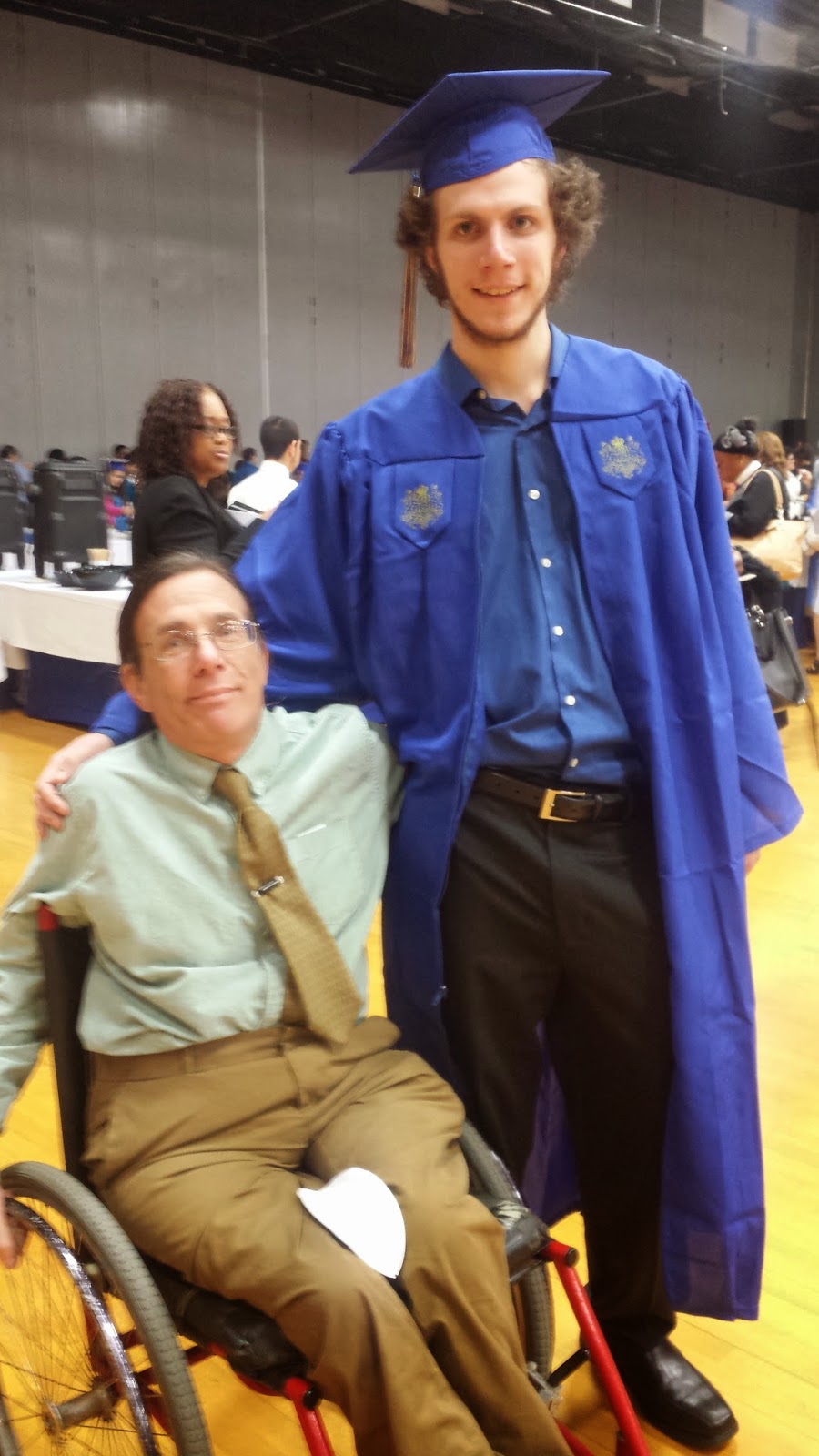
Exiled to Special Places is a line from Harriet McBryde Johnson’s classic essay the “Disability Gulag” published by the New York Times in 2003. It is a brilliant piece of writing. Johnson could be folksy, touching, legalistic, academic, charming, and pointed all in one short paragraph. I have been thinking of Johnson all week. Like many other people with a disability I live, work, and travel differently. Each and every time I travel or go to a large ceremonial event I am reminded I live in the metaphorical disability gulag: that is we are apart from others, typical others, the physical and social environment was built for. We people with a disability are thought to be powerless and dependent. Our presence is not wanted. Our bodies are a tragic reminder of the way life can go long. Hence institutions were built and staffed to care us—this is our history, one of social isolation, abuse, and segregation. We people with a disability are “special”. We are needy and society has a choice—out of the goodness of our collective hearts we will make the physical environment accessible; with the ever present proviso if it does not cost too much. Yes the disability gulag is a real place. It exists metaphorically and physically. Last week when I attended my son’s graduation from Hofstra University where I was put in a very real and demeaning gulag called “special needs seating”. 

Before I attended my son’s graduation ceremony I was worried. The information on the Hofstra website about commencement was badly dated. I emailed and called the commencement office. No reply. I asked my son to stop by the commencement office and ask about wheelchair access. The office location listed was incorrect. No one knew where or if a commencement office existed. I was tense and worried when I read the below:

Special Needs for Seating
David S. Mack Sports and Exhibition Complex Accessibility: This facility is wheelchair accessible on the main level and will be available for guests requiring this area. One family member may accompany those with special needs in this area during the ceremony. Upon entrance to the Arena, please contact an usher who will be happy to escort you.
It was my hope the above drop down tab from the commencement website page  was wrong. Based on 30+ years of experience, I assume when I read an antiquated statement about “special needs for seating" that I am screwed. Do not worry I told myself. Hofstra has a long legacy of being extremely progressive in disability rights and disability access. When I was a student at Hofstra (1978-1982) the professed goal of the university was to make the campus 100% accessible. I was a founding member of the Program for the Higher Education of the Disabled or PHED in 1978—an acronym I hated then and now. Have faith I told my son and ex-wife. Hofstra was at the forefront of disability access well before the ADA was conceived. They will not force us into a disability gulag. They will not enforce the discriminatory practice of one wheelchair, one “companion”.  There will be dispersed seating and we will have a host of options like all other who walk in the door. I was wrong. I was firmly placed in a real life disability gulag. 
I was escorted to a wide aisle. I was sure to be bumped and jostled every time a person walked by. My view left much to be desired. 


Who gets to sit in the aisle for special seating? Me and other undesirables. Largely gray haired old ladies and people such as myself. I was stunned. I was not impressed. Is this where any human being would want to sit? This is not where i would want my mother or grand parents to sit. But I might be wrong--out of sight and out of mind. The legacy of exclusion thrives to this day. Dump the undesirables in the aisle. 

There is a speakers podium. I could see it if I bent over or moved back--far back into the wide aisle. Yes, the bar placement is perfectly placed to be at eye level. The ushers were polite but clueless. I told them this was unacceptable. They agreed. Nothing could be done. Sorry. No effort was made to help me. Help as in find a place for me and one companion to sit that did not have an obstructed view. I was furious but did not want to ruin the day for my son. I thought about leaving in protest but that would accomplish nothing. I sat and seethed in anger. What made me so angry was the fact that it would be very easy to provide dispersed special seating. There was an elevator that went to stage level and seating above me. Any number of areas would work well. There was plenty of space. The failure was not architectural. Not a single person put serious thought into inclusion. Special seating is a problem. The easy solution, the thoughtless solution, is to make two large areas on the main floor with an obstructed view and call it a day. Who cares? No one. Does it matter that Grandma cannot see the podium? No. Did anyone think perhaps a paralyzed man such as myself would be present whose son was graduating and would like to see him walk across the stage? No. Hofstra as an institution failed. They built a disability gulag. One and all should be ashamed. Do not give me the worn out excuse that the facility is old. The Mack Sports Complex was built in 1998--the post ADA era. No excuses here. None.  
As I sat and seethed I finally thought screw this. I navigated my way to the elevator and was going to sit where I wanted. A place where I could see my son walk across the stage and even see the podium where people would speak. I went down the elevator and as I did the the academic precession was organized and ready to march in. I moved to a good spot, in the back but with an unobstructed view. I was quickly told: 'You cannot sit here. We cannot accommodate your special needs". I replied "I am not a child, special needs seating is unacceptable and you will accommodate me here. My son is graduating".  The social interaction was tense. The ceremony was about to begin. A scene could erupt. I suggested that I could accost the President of the university for his opinion as he was about 15 few feet away. The usher knew I was not going to move. I was an uppity cripple and the timing was bad. The show had to start and the easy way to solve the problem, my existence, was to do nothing. The usher did nothing. 
As I sat and listened to the speakers who were mercifully brief I thought about the unwanted above me. My people were getting screwed. Needlessly screwed too. I thought of the slogan "nothing about us without us" and "our home not nursing homes". I thought of Johnson who wrote:
We know better. Integrated into communities, we ride the city bus or our own cars instead of medical transportation. We enjoy friends instead of recreational therapy. We get our food from supermarkets instead of from dietitians. We go to work instead of to day programs. Our needs become less "special" and more like the ordinary needs that are routinely met in society. In freedom, we can do our bit to meet the needs of others. We might prove too valuable to be put away.
Despite 40 years of progressive legislation aimed at empowering people with a disability remain disenfranchised. I am sure not a single person that attended the graduation ceremony that walked by special needs seating gave it a second thought. Why are so many elderly people and wheelchair users jammed into two spots? The answer is simple: it is the symbolic representation of a century of oppression. 
As I made a very long drive home yesterday I was torn. I am weary of access always being a problem. Nothing is ever simple. Not even graduation at a university such as Hofstra that has an outstanding reputation in terms of disability rights. I grew depressed this morning util I took a short break and discovered I am not a lone. I am not the lone voice in the wilderness crying out. Stephen Kuusisto wrote: 
if you were a person with a disability at Iowa’s commencement and you desired a seat, perhaps with your family, you were out of luck. One of the reasons I left the U of Iowa was the institutions general and ubiquitous unconcern for people with disabilities. The disability seating in the “Carver Hawkeye Arena” is pre-ADA seating, at the top of the stadium; so far from the action you might as well stay home... Hofstra’s commencement was every bit as disgraceful as Iowa’s arrangement. Now this isn’t a scientific sampling. Two parents with disabilities, two campuses, but ask yourself about academic culture and disability. Iowa’s student services office for disabilities is located in the basement of a dormitory where people with wheelchairs can’t in fact “get out” if there’s a power failure. The architectural and administrative message couldn’t be clearer: disability is a ghetto; its marginalized; its not important for the able bodied general administrative population to think about. Link: http://www.stephenkuusisto.com/uncategorized/disability-and-the-end-of-another-academic-year
Shame on Iowa. Shame on Hofstra. Shame on academia for being just as discriminatory as mainstream society. I expect much more from Ivory Tower culture. Sadly, I am routinely disappointed. But I refuse to to be silent. I will not be meek. And I will not let this issue drop. I am going rattle some cages at Hofstra next week. I did not let the lack of access ruin my son's day. I am proud and chuckle that somewhere along the line I spawned an adult I am proud of my boy.